Rosie couldn’t get a mortgage in London and decided to buy a forest house in Sweden

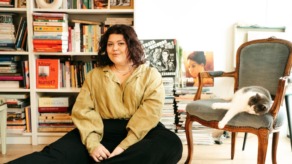
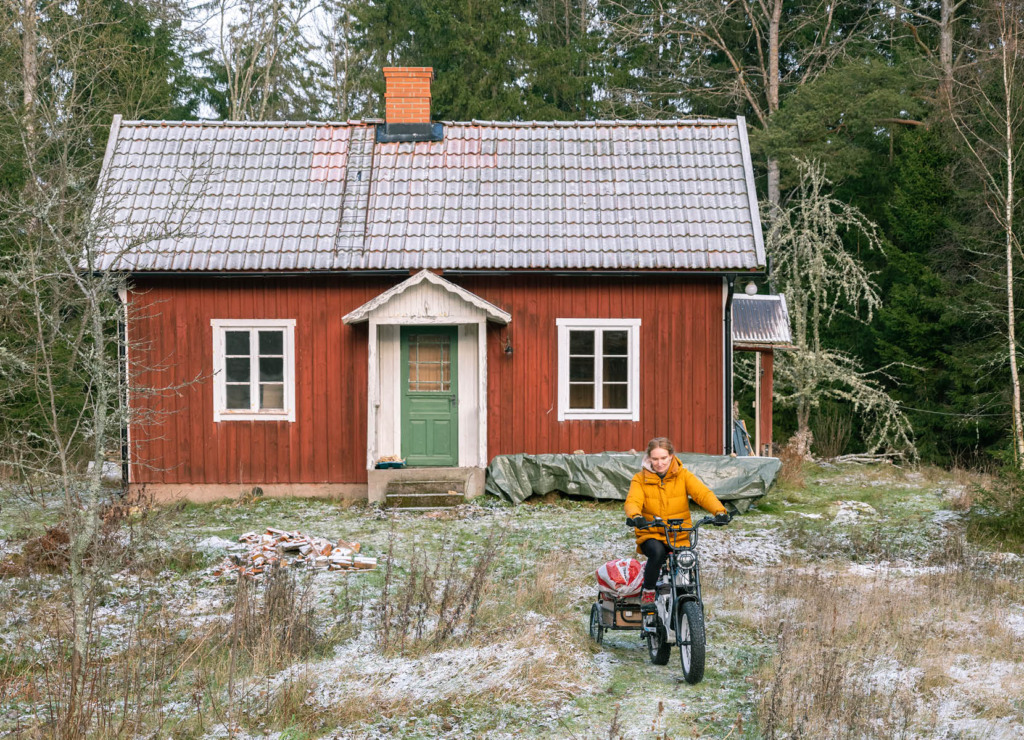
Rosie Hood-King lives in a remote Swedish forestcabin which she is fixingup single-handedly.
Little red houses for €10,000
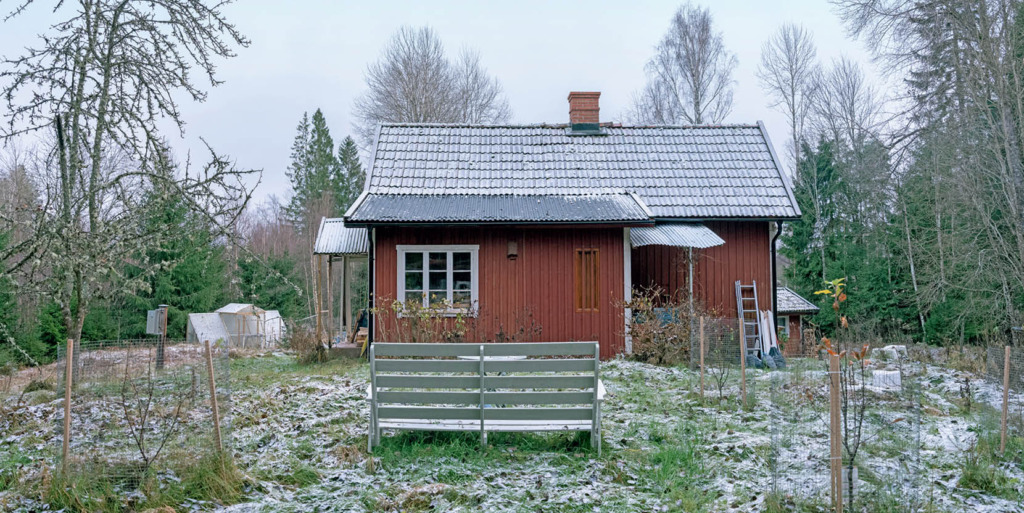
‘I had been working as an interior designer in London for ten years, but still couldn’t get a mortgage big enough to buy an apartment. On YouTube I saw people buying a house in Sweden for about €10,000 and I decided that’s what I would do. After seeing ten other places, I fell in love with this house. With a good 40m2, it’s perfect for just me. There are no cars here, no near neighbors. I’m surrounded by forest, which is exactly what I wanted. This house had been lived in by two brothers with their families until the 1990s, after that it was used as a summer house for a long time. It’s badly insulated, it didn’t have a working fireplace and the woodwork needed replacing. A lot of work had to be done to make it habitable, but I just thought: ‘Everything that needs doing can be learned’.’
About Sweden
‘In Europe, if you’re a freelancer and you can’t get a mortgage for an affordable house, there are various options, such as Sweden, Portugal and Slovenia. I thought with my character I would fit best in Sweden, where people are more introverted than in the other two countries. I also like the climate better; I wouldn’t be happy in a country that has quite hot weather. Before I moved here, I didn’t really feel any connection with Sweden, even though I had been here on vacation with my parents as a child. The only thing I remembered was the Swedish nature, there is so much of it here, which I love. The country really is just one big forest.’
Living downstairs
‘At first, I wanted to tackle the entire house, which has two stories. I had decided that I wanted my bedroom upstairs. But then I would have to put in new beams and how would I get them up there on my own? So I quickly abandoned that plan and focused on the ground floor instead. It has a kitchen, a bathroom and two rooms. One room is going to be a place to work and eat, the other will have a double bed and a large closet, which I still have to build. I’m a big believer in multifunctional spaces.’
No dedicated bedroom
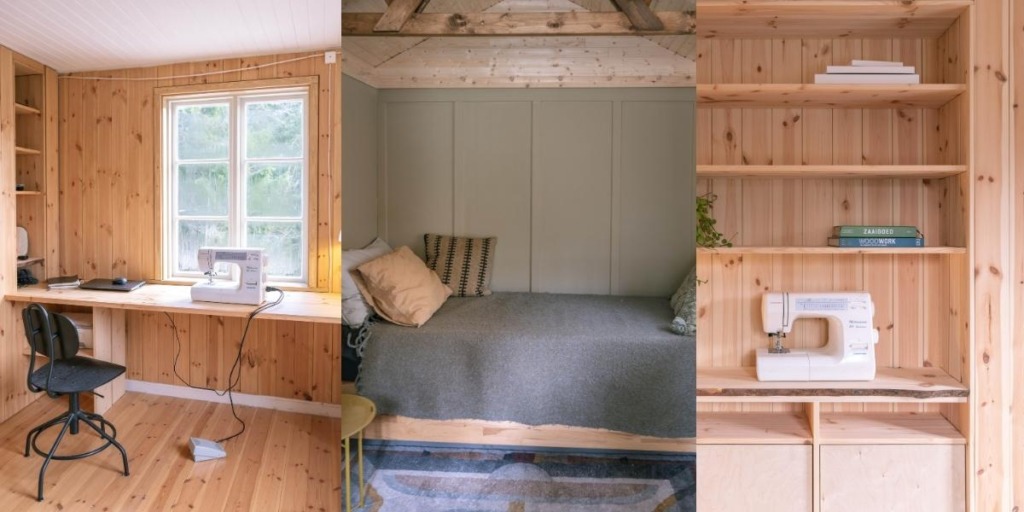
‘I think it’s a pity to reserve one room just for sleeping, especially in a small house like this. If you only sleep in a room, you don’t really make the most of that space. There are clever ways to build foldaway beds. In the study-slash-dining room, I built a pull-out single bed that functions as a sofa during the day—inspired by a photograph of a caravan renovation. In the other room I’m making a mobile double bed.’
Making something myself
‘I used to design very luxurious interiors for wealthy clients, and I would incorporate intricate details and expensive materials. For my own house I had to sober up my approach, because I’m doing everything myself on a smaller budget and with fewer materials and skills at my disposal. I made a technical drawing, like I always do as an interior designer, but as my own handyman this time, I found out that my drawing wasn’t realistic. It became clear pretty quickly that actual building is completely different to designing. But I do my best and if something is just a little bit wonky, then so be it. I’m not aiming for perfection here. The experience of making something myself is more important to me.’
Build with wood
‘The other day someone came to my house to sweep my chimney. He told me that my interior reminded him of a sauna from the 70s. I get that, everything is made of light, natural wood: my self-built sofa, the cupboards, table and kitchen. Because the hardware store is far away and I do everything by bicycle and without the money needed for expensive materials, I decided to build with wood. It’s the easiest to work with: you just saw it. Iron needs to be welded, and cement is very heavy. Since this interior is already a big project for me, I don’t want to make it harder for myself than necessary. And wood looks nice, you know. I think it’s a great compromise between what is possible and what is beautiful.’
Japandi-style
‘Besides the comparison to ‘a sauna from the 70s’, I also often describe my interior as ‘Japandi-style’—a mix of Japanese and Scandinavian. In Japan, they’re great at making the most of small spaces. I love the clean simplicity of the interiors there; a lot is handmade and constructed with ingenious details. They don’t use screws to connect two planks together, for example, but invisible parts, like wooden pegs in holes. I’ve been using that method in my kitchen too. The more I build, the better I’m getting at these little elements. It’s really fun to create a functional interior that’s also beautiful.’
Sleek and warm
‘A lot of what I’ve made so far is built-in: from the wall cupboard and my desk to the kitchen cabinets and my couch. I love that architectural style; it creates order and clarity. I also really enjoy its clean lines. That really makes me happy: a sleek but still warm ambiance. The disadvantage of built-in is that I won’t be able to take my furniture with me if I move. But that’s fine, I will have lived with it and enjoyed it while it lasted.’
Accessories
‘To be honest, I’m not really into accessories, so my cabinets are still mostly empty. At first, I wanted to make literally everything myself, but that was overly ambitious. My self-made lamp, for example, was a warped, useless failure. So I gave in and bought a couple of lamps. Sometimes I also like buying little things, such as cabinet knobs. It feels very luxurious when I don’t make it myself for a change.’
DIY inspiration from Pinterest
‘You don’t have to be a trained handyman to undertake a renovation; you just need to have the will. Maybe some people are better at it than others, but everyone can do it. I get my DIY inspiration from blogs and photos. Although I’m recording my renovation and putting it on YouTube, I personally haven’t looked up DIY videos much. I don’t feel like watching a whole video. That’s why Pinterest is so useful. There, you can find exploded-views, of a cabinet for example, whose parts have been pulled apart. That way you can see at a glance how it’s made.’
Mode of transport
‘I don’t have a driver’s license, and anyway, a bicycle is cheaper than a car and gives you more exercise. A folding bike with panniers was my very first purchase when I arrived in Sweden two years ago. I cycled from Stockholm to my house in five days. Now I have an electric bike with a cart, so I can carry more. That’s a great luxury and it goes super-fast. But ideally, I’d be able to walk everywhere. As an avid hiker, my legs are actually my favorite mode of transportation.’
Rosie’s DIY videos are on YouTube: Roaming Wild Rosie.
Read more
- The Swedish lifestyle of Elisabeth Dunker.
- Discover Flow Paper Book for Nature Lovers.
- The illustrations of Becca Stadtlander.
Interview Grete Simkuté Photography Eva Donckers