The joy of painting the same shape over and over again: 5 exercises to start with color meditation

The principles of color meditation are simple: Choose a shape, repeat it, change color and fill your page. The repetitive actions relax your body and calm your mind. And the good thing is: you can’t go wrong.
A daily color meditation
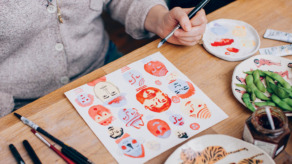
Artist and educator Lisa Solomon offers the class ‘Color Meditation Daily Practice’ on creativebug.com. She gives you a new painting assignment each day, for 30 days. Solomon makes it easy by choosing the color palette and shape per meditation for you. Circles, an arc, a triangle and so on—you don’t need to think or worry about what to do next.
Solomon started color meditation by chance. ‘Whenever I bought a new paint, I would test the colors by making color graphs and drawing dashes. After my daughter was born, I started meditating, but I found it difficult to sit still and keep it up. One day I had to try out some things for an art project with garlands. I started painting garlands in my sketchbook by painting a lot of dots in a row. While I was doing this—one dot at a time and always carefully choosing the colors—I noticed how my body relaxed and my mind went blank. It felt like meditating. Now I think it is a lovely way to start or end my day.’
Bringing back the joy of drawing
Perhaps you really love drawing and painting, but do it less than you would like to. During busy times in particular, it might disappear into the background and Netflix wins, despite the fact that you know that drawing gives you more energy. And the longer you don’t draw, the harder it is to start again.
Color meditations are perfect for that. They’re a kind of warm-up: exercises without any pressure. There’s no risk of failure. Every lesson, Solomon explains what to do, so you could let go of the ‘What will I paint now?’.
Color meditation might be a good way to trick yourself: ‘No, you’re not going to draw, you’re just going to repeat some shapes’. If you continued drawing after that, all well and good. And if you didn’t, that’s fine, too.
Learning about colors
Flow’s Creative managing editor Caroline decided to take Lisa Solomon’s online course. ‘What I hadn’t realized beforehand is that, during these color meditations, I would learn a lot of new things about color. What a wonderful bonus. I realize how little I actually knew about color and how little I normally dared to experiment. I have bought many beautiful pots of watercolor paint over the years, but how can I actually mix a color myself? I had no idea.
Because I saw Solomon mix up everything in her videos and also saw that she’s not afraid to make a mucky brown color, I became more daring. She makes her paint boxes very dirty and doesn’t seem to mind the colors in her palette getting mixed up—something I’m always worried about. Because I used to think it ruins the paint immediately.
So it turns out that I have (once again) been afraid of something without reason, because with some extra water you can just wash off the color that does not belong there. I’ve discovered what happens to color when you gradually add more white (‘tint’), or black (‘shade’). Everywhere, like Solomon, I now add a lot more water than I used to.
I realized once again that you only learn by doing, by practicing, by experimenting. The color meditations are so nice because they’re a form of play. That’s really how it feels. Instead of working on the end result, I’m researching things. Thanks to these regular meditations, drawing has become part of my daily life again.’
No end goal, no perfectionism
It’s fascinating that something without purpose can be so fulfilling. Because there’s no end goal in color meditation, you can choose colors, shapes and proportions much more intuitively.
“Okay, I’m stopping”, Solomon says at the end of her videos, as she approves the result of her color meditation. Often there’s still room on her paper for more, but you can see her thinking that it’s enough, it’s good. There’s no room for perfectionism during color meditation. How perfect.
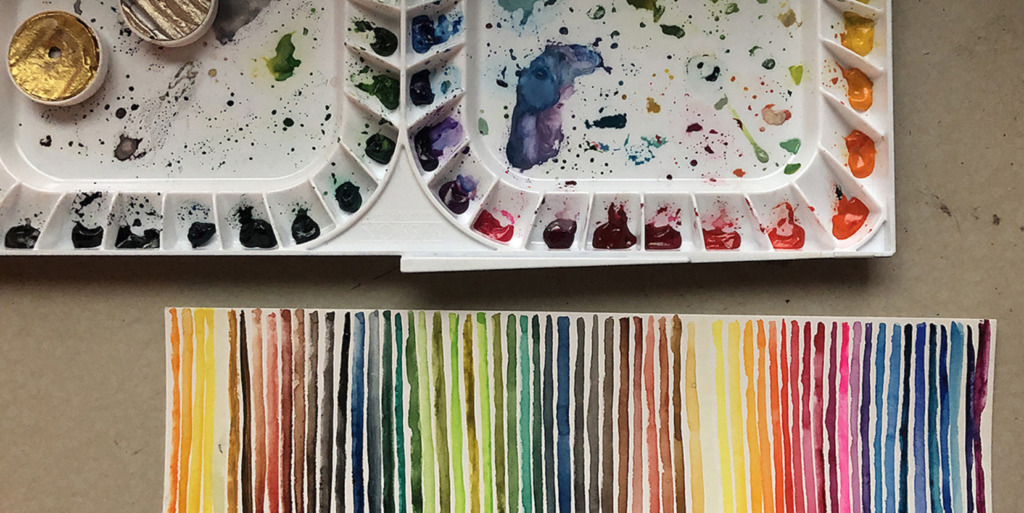
5 exercises to start with color meditation
What you need:
Paint
Good-quality watercolor paint with a lot of pigment gives you the best colors and doesn’t fade as quickly. That doesn’t mean, however, that you can’t do these exercises with any water-based paints that you have. You can do almost all the exercises with a bare-bones set of red, blue, yellow, white, black and brown. However, more colors equals more fun, so a set with the following colors is a great way to start: titanium white, ivory black, yellow, warm yellow, scarlet, crimson, rose, ultramarine blue, cerulean, phthalo blue, phthalo green, yellow ochre, burnt sienna or burnt orange, raw or burnt umber.
Other materials
- Paper
- A number of brushes of different sizes and shapes
- Paper towels or a blot cloth
- Palette (a dinner plate also works)
- Pocket color wheel: not essential but useful to remind yourself what happens when you
Exercise 1: Dots
- Pick a medium brush.
- Start with the first color from your paint box.
- Add plenty of water and cover your brush with paint.
- Put a dot on the top left and keep making dots until there is no more paint on your brush.
- Move to the next color, and repeat.
- Continue until you’ve used all the colors in the box.
- Work from left to right and from top to bottom
- You can make your dots large, small or even vary the size.
Exercise 2: Macarons
- Choose five colors that you feel look nice together.
- Choose a brush.
- Paint half ovals, placing them opposite each other (like macarons)—make sure they don’t touch. It doesn’t matter if they do, though. Such ‘accidents’ often result in pretty effects of different colors running into each other.
- Vary the intensity of the colors by mixing in different amounts of water.
- Position the macarons whichever way you like; in neat rows or randomly over the page.
Exercise 3: Arches
- Use all the colors in your paint box.
- Choose a brush.
- Paint an arch in one color.
- Add a little bit of white to this color and paint another arch underneath the first one.
- Mix in a tiny bit of black to this color and paint another arch underneath the previous one.
- Keep going with the next color, until the page is full.
Exercise 4: Color detective
- Find a photo or an image that you like.
- Look closely at which colors you see, also noting the various color tones. If it’s an image with a lot of green, for example, it’s usually not just one kind of green.
- Try to copy the colors. You can mix the colors, as well as play with the color intensity by mixing in more or less water, or by adding white or black.
- Paint one swatch per color, just like the color swatches you get at a paint store or home improvement retailer.
Exercise 5: Squares
- Pick five colors (try to go for ones that you might not normally choose).
- Use a flat, thin brush.
- Use one color to draw a few horizontal lines across the page.
- Pick another color to paint vertical lines from the top to the bottom of the page. You don’t need to wait for the first colors to dry. Watch what happens when the vertical stripes touch the horizontal ones.
- Vary the width of the stripes and observe what kind of grid they make.
- Keep going until you’ve used all five colors.
Want to know and see more?
- A Field Guide to Color: A Watercolor Workbook, by Lisa Solomon.
- The Color Meditation Deck: 500+ Prompts to Explore Watercolor and Spark Your Creativity, by Lisa Solomon
- You’ll find Lisa Solomon’s class ‘Color Meditation Daily Practice’ on Creativebug.com.
- Instagram: @a_field_guide_to_color; @lisasolomon
Text and photography Caroline Buijs