Paper, scissors, glue: how to make a vision board

Whether you’re focusing on a goal, wish or desire: by making your own vision board, you’ll find more clarity about what you truly want. This is how to start.
Good intentions have a tendency to fade or simply be forgotten as time progresses. The same can happen with the goals we set ourselves. You might have second thoughts about if they’re all that achievable. Or you’re not quite sure how to start. If that rings true with you, then whip out a stack of magazines and put the scissors and glue on the table. Because creating a goal vision board—a collage of images of what you’d like to achieve—can help you on your way.
Get a grip on your ideas
Ideally, you start a vision board with a clear objective in mind. Perhaps that sounds too businesslike for you: like a goal that has to be achieved with iron discipline and perseverance. You can also call it a wish or a desire. What matters is that you’re aware of the direction you want to go and how you envision that future. Because setting your sights on where you’re headed is motivating and boosts your self-confidence.
The more precise and concrete you are about your wishes, the clearer the path you’ll take from where you are now. This way, you can also keep track of how far you’ve come along your journey.
With a vision board, the end point becomes something visible. The great thing about such a board is that it’s a creative and practical way to map out goals and consciously give them attention. To set aside time to reflect on what’s important for you and to figure out what you want.
‘You make everything that’s in your head and your heart visible by finding words and images for it’
A mirror or your inner world
‘Even if your goals aren’t all that clear yet, a vision board can be really helpful,’ says Frederike Everts. As an executive coach, she guides people who want to take a new step in their careers, among other things. ‘What often happens is that countless thoughts are swirling around in your head. Try making a coherent plan out of that. By mapping out your ideas, you gain more control over them.’
Everts made her first vision board when she wanted to give her life a new direction after her divorce. ‘It helped me to reset. Later, I used it again when I wanted to move in a different direction in my career. The last vision board I made is now hanging on my office wall: last year I emigrated to France.’ Because even then, Everts started out with a vision board: What should the place where she was going to live ideally look like, how did she want to steer her life, what could it bring her? ‘The place I found, in the Gers in southwestern France, has everything I wanted. I can receive people here, individually or in groups, for coaching and training.’
Vision boards ensure that you make your plans precise and concrete, and that’s also where their power lies, Everts explains. ‘It helps you to keep seeing where you want to go. I see it as a mirroring of your inner world. You make everything that’s in your head and your heart visible by finding words and images for it. That can also help when making choices and, afterwards, to stay focused.’
What to use
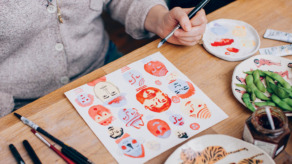
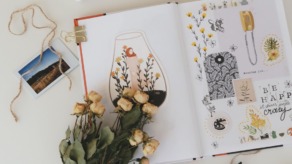
Creating a vision board is also a lovely activity. You start with a large sheet of paper, or a piece of fabric (that works too). On this surface, you glue, sew, draw or paint everything related to your wishes or goals, no matter how small. Everything is usable: from magazine pictures to your own photos, from illustrations to color swatches and texts.
Above all, Everts says, use your intuition. ‘So, when you’re getting everything ready, simply pick all the photos, pictures, illustrations or sentences that appeal to you, even if you don’t yet know how they relate to your goal. Then, when you start putting your vision board together, ask yourself: “What relevance does this have for my future?”’ There’s no right or wrong way. ‘Personally, I just love getting started with a stack of magazines, scissors and glue, just cutting and tearing,’ Everts says.
Different vision boards for different goals
A vision board can be interesting not only for your career plans, but also for your relationships, friends and family. ‘By all making your own version, you can check with each other and see if you’re on the same track,’ Everts explains. ‘This way, you’re mapping out your shared motivations and goals. And perhaps, even more importantly, how they differ from each other.’ Suppose you want to start a business together, for example: Does your work ethic align? Or if you’re considering buying a holiday home or a mobile home with a group of friends: Are you all dreaming of the same thing?
‘Discussing these boards can be a useful way to understand each other even better,’ says Everts. ‘You’re then starting a new adventure or a new phase with realistic goals and expectations.’ It’s important that you discuss in advance how you will approach the process. ‘The intention is not to influence or steer each other in a certain direction, but to inspire each other,” Everts says. ‘For example, ask each other: “What appeals to you about this? What feeling does this image or text evoke in you? Where does that come from? How would you like to see that feature in the future?”’
Tip: hang it somewhere prominent
Once your vision board is finished, you can place it somewhere special. If you hang it somewhere prominent—for example on your refrigerator door, above your desk or on the inside of a kitchen cabinet—you’ll see it every day. And that helps you consciously pay attention to it at regular intervals and get closer and closer to your goal.
Getting started: how to make your own vision board
You’ll need
- A blank surface to work on (a sheet of paper, artists’ canvas, fabric)
- Pair of scissors
- Glue
- Magazines and newspapers, your own photos, packaging material, beautiful paper, leftover scraps of fabric, etc.
- Pens, pencils, paint and brushes to also draw, paint or write with (optional)
Set a goal
Don’t have a clear picture of your goals yet? These tips might help you:
- Make a list of all of your plans, wishes and ideas about the future. Write down everything that comes to mind.
- Make a top ten from that list. If you’d have to choose, what or who is more important to you? Sometimes it can help to break down large goals or long-term plans into smaller steps, with a focus on a one- or two-year term. Later on, you can make another board.
- If you have a wish that plays across different areas of your life—for example home, relationships and work—you can also make a separate board for each area.
- Don’t let yourself be limited by everything you don’t yet know or that is currently still uncertain. Ask yourself: ‘What do I know right now?’ And then start there.
Source: Frederike Everts
Practical tips
- If you already have a clearly defined goal, then magazines that have links to that goal are the best to use. Home magazines for a new house, for example, art magazines if you want to do something with creativity, and so on.
- Be specific about your goals. Think about what type of plants you would like in your dream garden, what colors you would like to paint your house, etc.
- You’re making this vision board for yourself. Anything goes, don’t censor any ideas or curb any thoughts. You don’t have to hang your collage in your living room where everyone can see it either, you can keep it for yourself and hang it in a secret place.
Add text
- If you’re using text in your vision board, make it positive. Your brain doesn’t process words such as ‘not’ or ‘no’, and just forgets them. If you write, ‘Do not be angry so often’, it will only remember the part ‘angry often’. So cut and paste positive slogans. ‘Make time to go for a walk’, for example. Or, ‘Learn to play the guitar’.
- Look for action words. Words such as ‘start’, ‘develop’ or ‘lead’.
- Taking time now and then to think about what you have already achieved helps to keep your goals in sight. It’s helpful to write down the steps you have already taken, no matter how small, in a notebook. You can do this on a weekly or even daily basis.
Make a collage
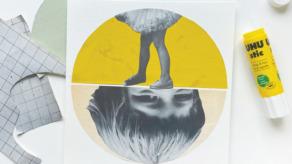
You can also let go of the idea of a vision board and just enjoy making a collage without a set goal, just for the fun of it. If you do like a little guidance to go by, these tips might help:
- Keep a specific theme in mind, for example: A self-portrait; the past, present and future; a world you’d love to live in. Hold that theme in the back of your mind and then see what comes up on the board.
- Take a dilemma as a starting point, for example: Do I want to live in the city or in the country?
- Try not to think too much beforehand about what you’re going to make. Make something with what you find, not with what you think up.
- Work in different sizes. For example, make a collage the size of a postcard, or even smaller.
- Try to leave some white places in your collage; that can create space. You don’t have to fill the whole surface.
- Use a photo of yourself in your collage and create a world or a house around your picture that you’d love to live in.
- Limiting the time can sometimes work well. For example, collect images for 25 minutes, spend another 25 minutes making something with those images, and finally, write about it for 10 minutes. What do you see? What comes to mind when you look at your collage?
- Another fun angle: spontaneously make collages with friends (and children) who come to visit.
Source: Frederike Dekkers, theartistsway.info
Want to read more?
- This is a shortened version of an article that previously appeared in Flow 41. Would you like to read more? Buy the latest Flow International here.
Text Klaartje Scheepers illustrations María Luque
Published on May 11, 2026